One Small Step For Man

November 11th, 2009

Since July 21 1969 the landing sites of the Apollo missions had not been seen until the LRO, Lunar Reconnaissance Orbiter, photographed them earlier this year.  Launched earlier this year the LRO’s mission was to take the highest resolution photographs ever of the surface in preparation for future moon landings.  Here is a photo released in July for the 40th anniversary of the first moon landing.  This photo and the original photos of the other landing sites were taken before LRO settled into its close orbit.  Here is Apollo 12, ClickThePic to visit the LRO website and see the high resolution versions.

Apollo12

Apollo 12 Landing Site

Now that LRO has settled into its permanent orbit the resolution is much better.  Depending on lighting and angle it is able to capture as little as 20 inches per pixel.  So what do we see with better resolution?  Check out the Apollo 11 landing site.

Apollo 11 Landing Site

Apollo 11 Landing Site

Remember the story of how Neil Armstrong saw that the computer was going to land them in a boulder field near West Crater.  If you look closely to the left of West Crater you can actually see some of the larger boulders strewn out towards Little West Crater.

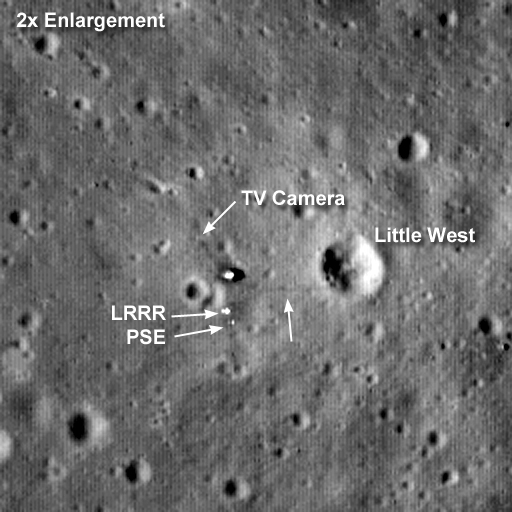
Here’s a closeup of the Lunar Module Descent Stage.

Closeup of the Apollo 11 Landing Site

Closeup of the Apollo 11 Landing Site

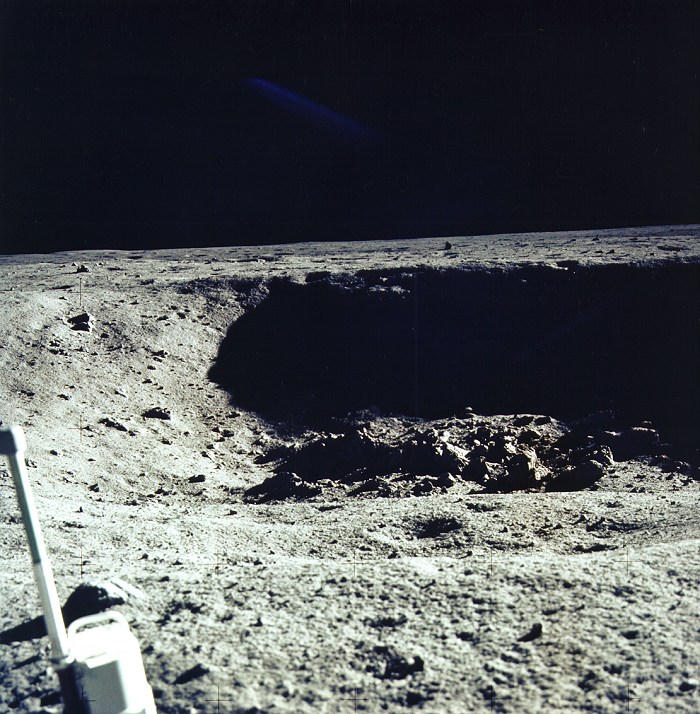
That darker line over the unmarked arrow towards Little West Crater are Neil Armstrong’s footprints, the brightest spot in the center is the descent stage.  The small crater to the left near the descent stage was photographed by Armstrong.  Here’s the picture from the Nasa Gallery.

Apollo 11 Little Crater

I don’t believe that anything captures my imagination more than these incredible images.

bob

Rare And Beautiful Emeralds

October 25th, 2009

I wish I could have shared this sooner, but the week leading up to Oct. 16 was John, my brother, and my Elk Hunt so I was busy getting ready to go.

In the morning sky at daybreak, 3 planets were in clear view.  The dimmest and closest to the dawn sun was Mercury.  The brightest was Venus and the third was Saturn.  You could see all 3 planets throughout the first 2 weeks of October if you were up before dawn and on the 16th a special appearance was made by a crescent moon.   John was able to share this view with me from 6700 feet up in the mountains on my friend John Toner’s property.  Clear skies, unseasonably warm weather, 15% humidity and no light pollution made for great observing and camping – but lousy elk hunting.

Oh well, at least we enjoyed the night sky even though the daytime was a bust.

Lucky elk.

bob

Oh How I Wish I Could Brag, But I Can’t

October 12th, 2009

Unfortunately it’s not me, it’s the equipment.

I was fine tuning my rifles to get ready for my elk hunk this Friday, Oct. 16 at the Ben Avery Range.  I was something of an interest to some of the other shooters.  8 other shooters stopped to watch me and ask questions about my rifle.  Apparently they were watching my target through their spotting scopes, curious that I was shooting a muzzleloader at 200 yards.  Many thought I was just messing around but were stunned that a smokepole (muzzleloader) could shoot accurately and consistently at that range.  Granted this is not a traditional muzzloader.  My muzzleloader is a Thompson Center Encore Endeavor, which is modern in-line, but still a muzzleloader.

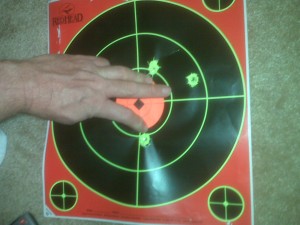
I was shooting 126 grains of FF Pyrodex Triple 7 with Barnes TMZ 250 grain bullets.  These are solid copper 45 caliber bullets in 50 caliber sabots.  Check out my last target.  It’ll get better because the gun is brand new, not yet seasoned.  By spring  I should be able to cut the size of this group in half.

 50 caliber

Again, Unfortunately it’s not me, it’s the equipment: I was shooting from a bench.

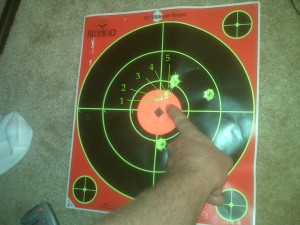
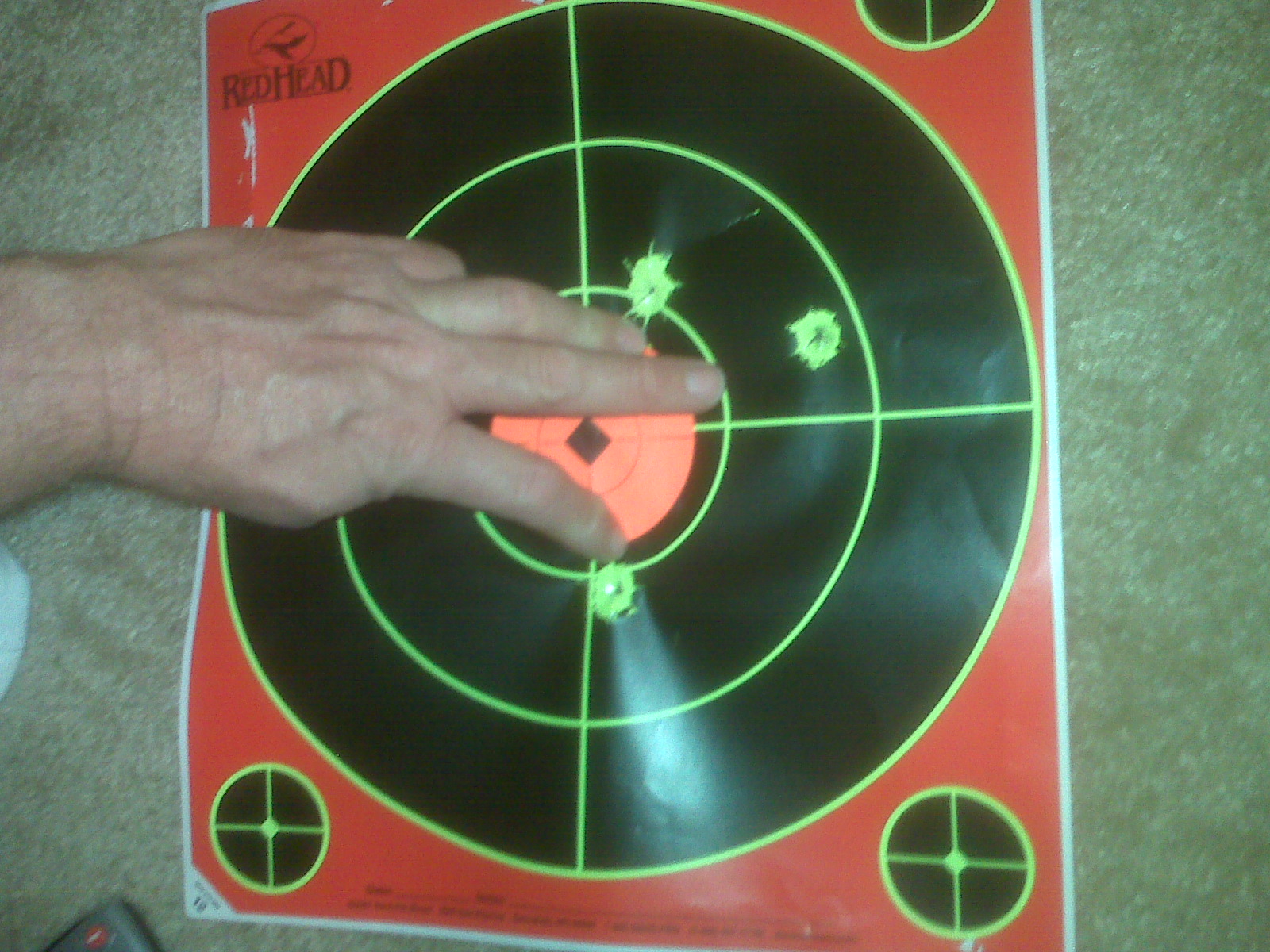
But you want to see something really amazing?  I checked the zero on the same target with my new Thompson Center Icon in 30 TC caliber 165 grain.  You can’t see the group because it is under my ring finger in the above photo.  Last five rounds from the second box – that would be shot numbers 36,37,38,39 and 40.  My Sako, Ruger or Browning can’t come anywhere near this with factory or custom ammo.  My Sako AII in 308 with a custom trigger and target crown can get close, but only with custom handloads and a lot of patience waitng for the barrel to cool.  The Icon is right out of the box and the rounds off the shelf at Cabela’s and shot bang, bang, bang with the barrel heated up after 27 rounds.

30 TC 200 Yards

As I said, I wish I could brag.  But shooting from a solid benchrest makes it a lot easier.  Remember, this is Hornady factory ammo, not custom reloads.  The powder for these rounds is not yet available to the public for handloads.  The 30 TC round is a little smaller than a 308 Winchester but 75 to 100 feet per second faster than a 30-06.  Also remember this is a lightweight sporting rifle, not a heavy barrel target rifle.  Can’t wait to reload this round someday.

Something else that is unfortunate is that the Icon is not selling well.  Thompson Center is not one of the big names like Remington or Ruger.  But this little company developed the Icon with a short, compact action, adjustable trigger, 3 lug bolt (most bolt actions are 2 lug), recessed target style crown, button rifled with 5R rifling and receiver integrated picatinny rail.  AND the rifle comes factory bedded wiht an aluminum integrated bedding block.  All this for around a $1,000.00 retail.  Shooters used to spend in excess of $3,000 to get these same features without the 5R rifling.

If I find the elk herds this weekend, it’ll be all the steak I can eat the rest of the year.

Can I brag a little?

I know, I know, only IF I find the elk.

bob

Check Out Jupiter Near The Moon

October 1st, 2009

Have you been watching that bright star near the moon the last few nights?  That’s Jupiter.  Get out your binoculars and look for the 4 Galilean moons, those bright pin pricks of light near the planet.  Left to right will be Ganymede first, then Europa second and Io right next to the planet.  If you ambitious look for Io’s shadow on Jupiter through your telescope.  On the right will be Callisto.

On October 2nd all 4 moons will be on the right side of Jupiter.

bob

Wha, Wha, What Happened?

September 28th, 2009

OK, so I’ve been gone for a while.  Between selling the house, the move to the apartment, problems over the money I spent setting up the blog and other life issues, I decided taking the time to do a blog was a bad idea. 

OK, so I was wrong.  Possum Holler is back with a vengeance.

The first few articles are designed to be fun; I especially like the one titled “Excited Thallium”.  See if you spot the name of the invention talked about in the post.

Ready or not, here we go…

Excited Thallium

September 28th, 2009

Who are those remarkable individuals that had ideas that changed the world?

 One individual is a man named Gordon Gould.  Ever heard of him?  His genius that profoundly impacts your daily life came from an idea of energy levels from “exited thallium”.  Initial uses were planned for spectrometry, interferometry, radar, and nuclear fusion.

 But now virtually everything used in modern electronics uses his invention.  Do you listen to CD’s?  Have you had surgery lately?  Do you know the most accurate way to measure something?  Copied something?  Leveled something?  Printed something?

Gordon Gould called it light amplification by stimulated emission of radiation.  Basically his idea was to take electromagnetic radiation (energy – or more popularly known as “light”) and separate the combined energy using an open resonator into individual wavelengths which are measured in nanometers.

I hope you caught the name of this remarkable invention from above.  If you missed it I’ll give you the name again:

Light Amplification by Stimulated Emission of Radiation.

Did you see it that time?

bob

Did You Wanna Be A Cowboy When You Were Little?

September 28th, 2009

   What’s more uniquely American than the American Cowboy?  Try to think of anything that defines this country more than punchin’ cows across northern Texas into places like Oklahoma, Missouri, Colorado and Nebraska carrying a six-shooter and a Winchester.  The American Cowboy is the iconic image of this country throughout the world.  Go to any other country, and I mean ANY other country and ask what is known about 19th century American history.  Yep, it’s the cowboy.  Romanticized on stage, screen and film.

   But was the “cowboy” always a respected member of the cattle drive?  Hardly; you can thank Buffalo Bill Cody and his Wild West Show and Hollywood for changing the term into something romantic and heroic.  Truth is that the term cowboy was used as a derogatory term in 2 different ways.

   1st: like a shepard in the bible, cattle drivers were on the bottom of social rung.  Dirty, poor, ruffian and couldn’t get any other job.

   2nd: cowboy was often used to describe a troublemaker, outlaw or thief.  In Tombstone the McLaury’s and Clantons were cattle theives and therefore referred to as “cowboys”.

So, Yipee Ki Yo Ki Yay - get along little dogie.

bob

Saturn at Equinox

September 28th, 2009

My last post in January, Saturn Goes Commando, is about Saturn at its equinox.  This means the rings are now edge on with the sun and at their thinnest from our vantage on earth.  You cannot see the rings at all from my astrobinoculars.  Check out this picture from Ciclops http://ciclops.org/view/5815/Shadow_South_of_Another?js=1

Saturn at Equinox

Saturn at Equinox

Ciclops.org is the official website for the Cassini mission.  Check it out.

If you look on the sphere of the planet you can see the razor thin shadow line of the rings.  That little bump on the ring shadow is the shadow of the moon Enceladus.  Enceladus is not in the picture since it orbits beyond the rings but it still casts a shadow on Saturn.

Man I love this stuff.

bob

Saturn Goes Commando

January 2nd, 2009

     The jewel of the solar system, Saturn, is going naked from our viewpoint for a while.  If you have a telescope, watch the ring plane disappear and reappear over the next few months.  The actual disappearance will be in September, but will be unobservable.  Saturn will be on the opposite side of the sun from us. 

     Saturn has a tilt of approximately 26.7 degrees, the Earth has a 23.5 degree tilt.  That means every so often our viewpoint crosses the ring plane and the rings disappear.  The rings are incredibly thin, a few yards at most, yet the full diameter of the rings is over 124,000 miles.  That ratio means that the rings would be far sharper than a razor in relation to its diameter.  Here’s a classic view of Saturn’s rings from www.spacetelescope.org.

Classic view of Saturn

Classic view of Saturn

     But this how Saturn looks now.  Seems almost naked without the rings.

Saturn Almost Naked

Saturn Almost Naked

     By the way, that’s Titan just above the rings to the left in the picture and that’s Titans shadow on the southern part of Saturn (image from the Hubble Space Telescope).  Titan is the only moon in the solar system that has an atmosphere, which is why it looks fuzzy.  Soon there will no rings to see at all, but in a few months beginning after September, they’ll start to reappear.
     By the way, Titan gives us another great reference to the size of Earth.  Titan is about 40 percent the diameter of Earth.  So picture that fuzzy orange dot a little over double the size and that gives you what Earth would look like in orbit around Saturn.  Saturn is the 2nd largest planet, behind Jupiter, in our solar system.
     bob

Ganymede Runs, But Can’t Hide

December 18th, 2008

Here’s one of the latest of thousands of photos from the Hubble Space Telescope.

That’s the moon Ganymede in its orbit going behind Jupiter.  Ganymede is the largest of the moons orbiting not only Jupiter, but the largest moon in the solar system.  It is slightly larger than Mercury with a diameter of 3,270 miles, (Mercury is 3,032 miles).  That means if it were in orbit around the sun, it would be classified as a planet.  It also gives the scale of the size of Jupiter.  Ganymede is approximately 40% the size of Earth.  If you look closely at the Great Red Spot on Jupiter, which is a gigantic storm that’s been raging for centuries, Earth would easily fit inside with plenty of room to spare.

bob